
Overview
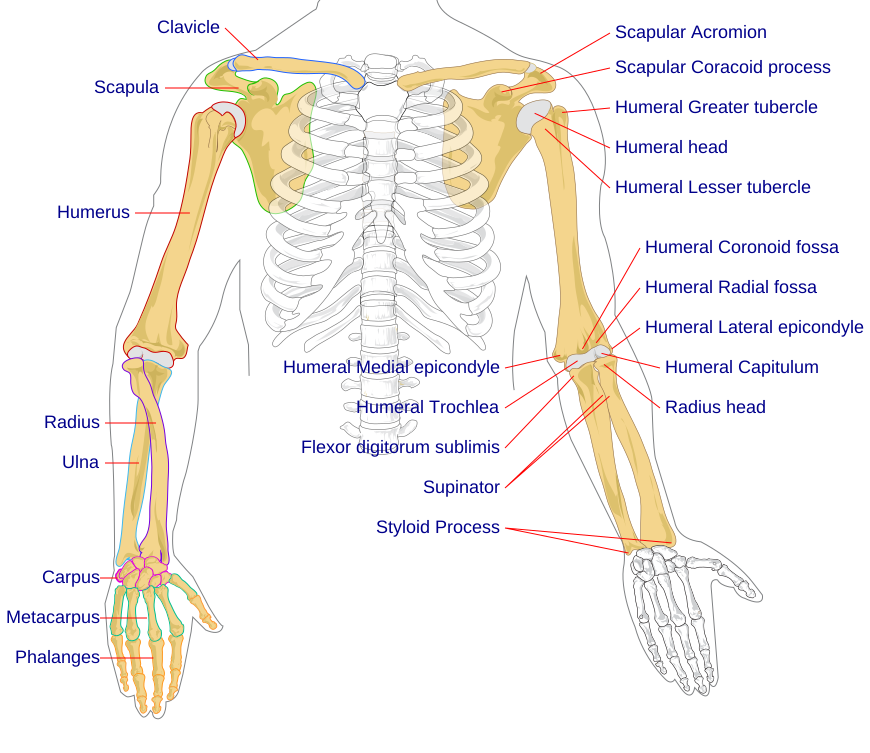
The radial head is the disk-shaped top of the radius that sits in the elbow joint and rotates during forearm supination and pronation. It is also a key stabilizer of the elbow. Many simple radial-head fractures heal well with early motion in a sling.
Surgery is considered for displaced fractures that block motion, for fractures associated with elbow instability (such as terrible-triad injuries), and for severely comminuted heads that cannot be reconstructed. In the last case, the head is replaced with a metal prosthesis rather than repaired.
Why it's done
Radial head fixation or replacement is typically considered when imaging and the clinical picture together indicate that the fracture will not reliably heal or function without surgical stabilization. Common indications include:
Displaced fracture blocking forearm rotation
A fragment that catches in the joint must be addressed.
Associated elbow instability
Terrible-triad or Essex-Lopresti injuries require reconstruction.
Fracture with more than three fragments
Reconstruction is typically unreliable; replacement is preferred.
Open fracture
Urgent debridement and stabilization.
How it works
For reparable fractures, headless compression screws or a small plate hold the fragments after a limited lateral approach. Implants are placed in the safe (non-articulating) zone of the radial head.
For unreconstructable heads, a modular metal radial head prosthesis is sized to match the patient's native head and inserted into the radial neck. The prosthesis restores elbow stability and allows immediate motion.
Recovery
Early range-of-motion is critical for all radial head surgery. A brief splint is used for comfort, then motion begins within days. Strengthening starts at six weeks. Full recovery typically takes three months. Stiffness, heterotopic ossification, and implant-related symptoms (in replacements) are known concerns. Hardware removal is rarely needed for fixation constructs.
Contact
For questions about this procedure or to schedule an evaluation, call the office at (830) 625-0009 or request an appointment online.
Further Reading
External patient-education references and related OSI pages for additional background: