
Platelet-Rich Plasma (PRP)
An injection made from your own blood — what it is, what the evidence supports, and how we use it.
What It Is
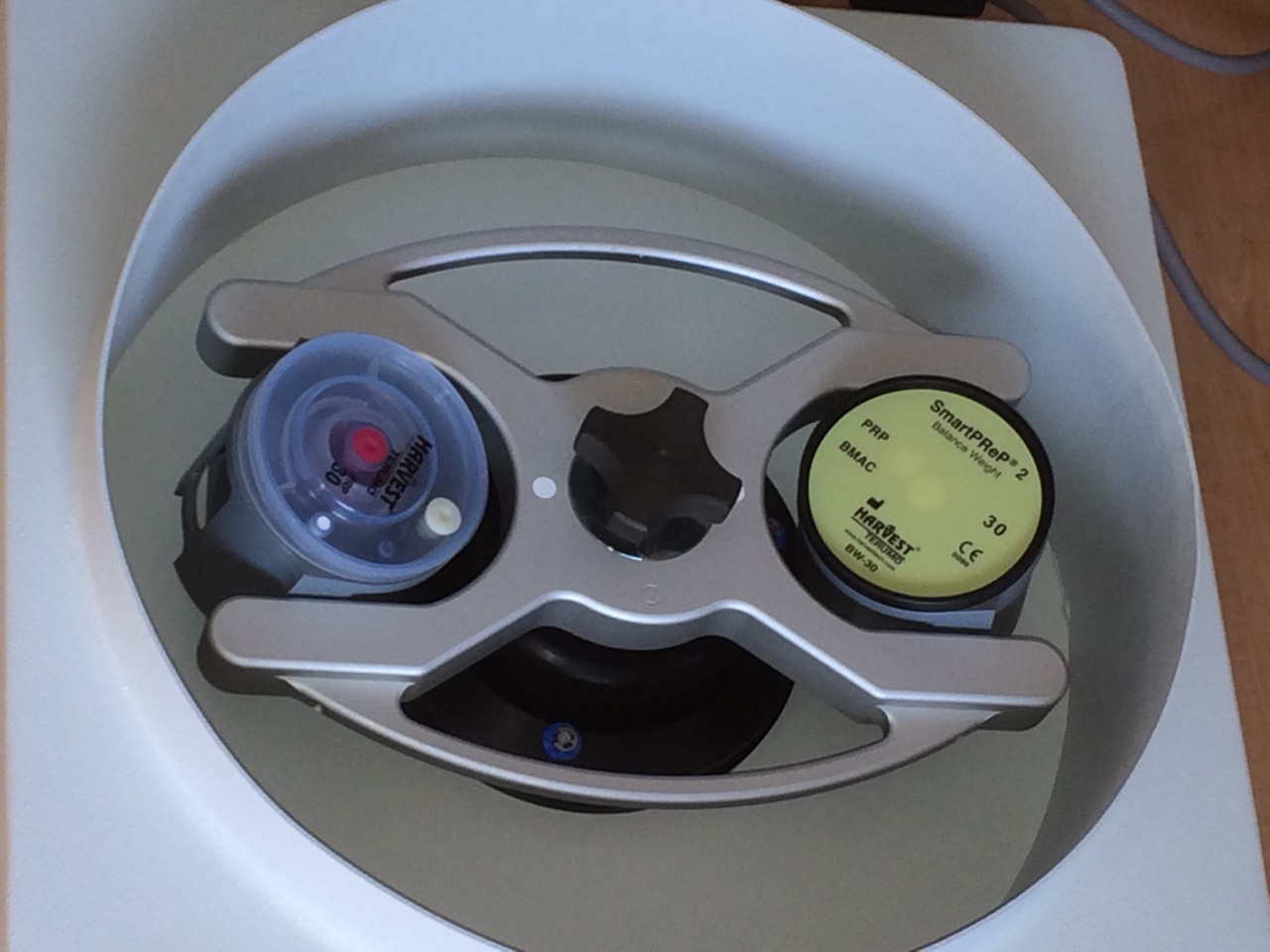
PRP is a small injection made from your own blood. We draw a tube of blood, spin it in a centrifuge to concentrate the platelets, and inject that concentrated layer into a painful tendon, ligament, or joint. Because the injection is made from your own body, there is no risk of rejection or disease transmission.
Platelets carry the body’s natural repair signals — the growth factors that kick off healing after an injury. The idea behind PRP is to deliver a stronger dose of those signals directly to a stubborn tendon problem or an arthritic joint that isn’t healing on its own.
Where the Evidence Is Strongest
- Tennis elbow — good-quality studies show PRP outperforms cortisone past 6 months, because cortisone helps quickly but doesn’t last.
- Early-to-moderate knee arthritis — modest but real improvements in pain and function at 6–12 months, often better than hyaluronic acid gel or saline in the first year.
- Jumper’s knee (patellar tendon) — helpful for long-standing cases that haven’t improved with physical therapy.
- Plantar fasciitis (heel pain) — comparable to or better than cortisone at the 6-month mark in several trials.
Where the Evidence Is Uncertain
- Rotator cuff irritation and small partial tears — results are mixed.
- Recent muscle pulls and strains — no clear advantage over standard rehab.
- Advanced, bone-on-bone hip or knee arthritis — limited benefit; joint replacement is usually a better answer.
Conditions We Consider It For
Early-to-moderate knee arthritis
Considered when anti-inflammatory pills, physical therapy, and a cortisone shot haven’t been enough and it’s too early for a knee replacement.
Tennis elbow
Long-standing outer-elbow pain that hasn’t responded to a counterforce strap and physical therapy.
Golfer’s elbow
Long-standing inner-elbow tendon pain with similar indications.
Jumper’s knee
Long-standing patellar tendon pain that hasn’t improved with rehab.
Achilles tendon pain
Selected long-standing cases in the mid-portion of the tendon.
Plantar fasciitis (heel pain)
When stretching, orthotics, and a prior shot haven’t worked.
Rotator cuff irritation
Selected cases without a full tear of the tendon.
Early hip arthritis
Considered in early disease; done with ultrasound guidance.
What to Expect
- A quick blood draw (about 1–3 tablespoons), 10–20 minutes in the centrifuge, then the injection — often with ultrasound to guide the needle into the right spot.
- Expect some extra soreness for 2–7 days. That’s part of how the treatment works, not a sign that something went wrong.
- Ice is fine. Avoid anti-inflammatory pills (ibuprofen, naproxen, Advil, Aleve) for 1–2 weeks before and after, since they blunt the effect.
- When it helps, improvement usually shows up somewhere between 4 and 12 weeks, and can keep getting better out to about 6 months.
- Some patients are offered a series of 2–3 injections spaced a few weeks apart.
Insurance and Cost
PRP is generally considered investigational by insurance carriers and is usually not covered, so it is paid out-of-pocket.
Our self-pay pricing is $1,000 for a single joint and $1,500 for bilateral joints treated in the same visit (both knees or both hips). A written estimate is provided before scheduling so there are no surprises.
Risks
- Post-injection soreness (expected) lasting days.
- Temporary swelling at the injection site.
- Infection — rare with sterile technique.
- No benefit — the most common “complication.” Response is not universal.
Next Steps
PRP is most useful when the diagnosis is clear and conservative measures have been tried. An in-person evaluation with imaging review is the right starting point. Request an appointment or call (830) 625-0009.